

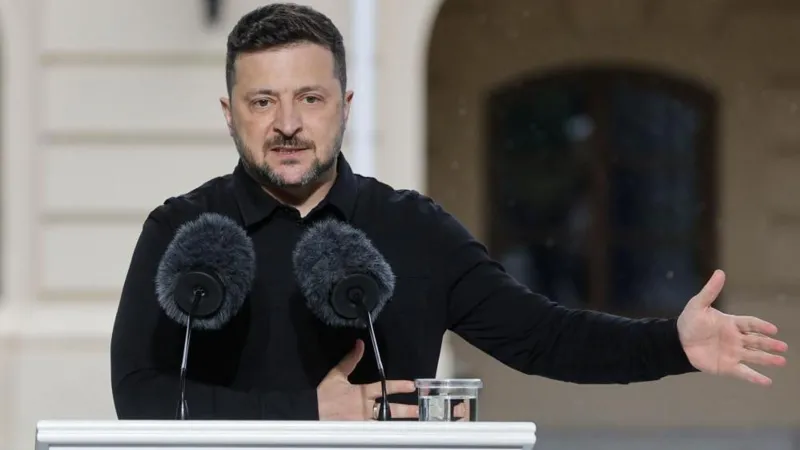
Zelensky Proposes Face-to-Face Talks in Letter to Putin

Every Russia-Ukraine Peace Attempt in 2026: A Year of Talks That Keep Failing
From Davos to Geneva to a rejected open letter — inside the eight-plus rounds of diplomacy that have yet to produce a single lasting breakthrough
A Year Defined by Near-Misses
Nearly four years into Russia’s full-scale invasion of Ukraine, 2026 has seen one of the most intense diplomatic pushes of the entire war — yet as the conflict approaches its fifth year, having killed more than a million people, no breakthrough has held. Here’s how the year’s negotiations actually unfolded, round by round.
January: Paris and the “Coalition of the Willing”
The year opened with momentum. On January 6, Ukraine’s allies — roughly 35 nations under the banner of the “Coalition of the Willing” — met in Paris and agreed to provide multilayered security guarantees for Ukraine as part of a broader peace framework. US envoy Steve Witkoff called it “significant progress,” citing agreement on a bilateral security guarantee framework and a “prosperity plan.” NATO Ambassador Matthew Whitaker said the deal would “free up” Zelensky to pursue a final agreement with Russia under a 20-point plan. Zelensky, in turn, thanked international partners for “very substantive discussions” on ceasefire monitoring.
Russia, notably, stayed silent — holding firm on territorial demands without publicly engaging on the substance of the Paris agreement.
Late January: Davos and the First Trilateral Talks
Weeks later, on January 22, Zelensky met Trump on the sidelines of the World Economic Forum in Davos. Zelensky said security guarantee terms had been “finalised” and a deal on post-war economic recovery was nearly ready. Trump described the meeting as “good,” and both sides announced that Ukraine, Russia, and the US would hold their first-ever trilateral talks in Abu Dhabi that weekend. NATO Secretary-General Mark Rutte welcomed the diplomatic push but cautioned against losing focus on Ukraine’s immediate military needs — a caveat that proved prescient, as Russian strikes that same week left much of Kyiv without electricity or heat in sub-zero temperatures.
Early February: Moscow, Florida, and Abu Dhabi
Diplomacy accelerated further in early February. Witkoff, Jared Kushner, and White House advisor Josh Gruenbaum traveled to Moscow to meet Putin directly, shortly after the Davos talks. That was followed by meetings in Florida between Witkoff and Russian special envoy Kirill Dmitriev, which Witkoff called “productive and constructive.” Around the same time, Trump announced that Putin had agreed to pause strikes on Kyiv for a week due to “record-setting cold” — a rare, if narrow, humanitarian gesture. Russia and Ukraine then held a further round of negotiations in Abu Dhabi.
On February 18, delegations led by US Secretary of State Marco Rubio and Russian Foreign Minister Sergei Lavrov met in Saudi Arabia, marking one of the more senior-level diplomatic engagements of the year to that point.
Mid-February: The Geneva Trilateral Talks
The most substantive negotiating round of the year came in Geneva on February 17-18, just a week ahead of the fourth anniversary of Russia’s invasion. Ukraine’s delegation was led by Rustem Umerov, Russia’s by Vladimir Medinsky. The first day’s talks ran six hours behind closed doors, with Umerov calling them “focused on practical issues” and Witkoff citing “meaningful progress.” A source close to the Russian delegation described the atmosphere as “very tense.”
The second day told a different story. Talks lasted less than two hours before ending “abruptly,” and lead US negotiators Witkoff and Kushner did not take part — a signal, according to US and Ukrainian officials, that momentum had stalled. Sticking points included the Donbas region and the fate of the Russian-controlled Zaporizhzhia Nuclear Power Plant.
Late February: The Iran War Intervenes
Just as the Ukraine track appeared to be building steam, the broader Middle East crisis intervened. Israel and the US struck Iranian targets on February 28, launching a parallel war that would consume much of the Trump administration’s diplomatic bandwidth for months. This shift in US attention became a recurring frustration for Zelensky throughout the rest of the year.
June: Zelensky’s Open Letter and Putin’s Rejection
By June, with the Iran war still dominating US foreign policy, Zelensky changed tactics — moving from closed-door negotiation rounds to a public, direct appeal. On June 4, he published an open letter to Putin proposing face-to-face talks in a neutral country, suggesting Switzerland, Turkey, or an Arab state, while explicitly ruling out Moscow and Kyiv as venues.
Putin rejected the offer the very next day at the St. Petersburg International Economic Forum, saying he saw “no point” in meeting “for now” and calling the letter “rude.” He set his own precondition instead: that Ukraine “stop the advance” of its forces before any leader-level meeting could occur. Zelensky called the response “weak” and said it showed Russia was “once again choosing war.”
Why None of This Has Produced a Breakthrough
Looking across the year, a consistent pattern emerges. Multilateral tracks (Paris, Davos) produce agreements on security guarantees and frameworks — the easier, less contentious parts of any deal. Direct Russia-Ukraine tracks (Geneva, Abu Dhabi, Zelensky’s June letter) consistently stall on the harder issues: territorial concessions, the sequencing of any ceasefire, and whether Russia’s battlefield demands must be met before or after negotiations begin. As one Al Jazeera analysis has noted, Trump’s 2024 campaign promise to end the war within “24 hours” of taking office remains, as of mid-2026, unfulfilled — not for lack of diplomatic activity, but because the core disagreement over territory has proven resistant to every format tried so far.
What to Watch
With the Iran war continuing to divide US diplomatic attention and Putin having set fresh preconditions in his response to Zelensky, the second half of 2026 looks likely to feature more of the same pattern: intermittent progress on peripheral issues, punctuated by stalled or rejected attempts at resolving the core territorial dispute at the heart of the war.


One thought on “Zelensky Proposes Face-to-Face Talks in Letter to Putin”