‘Begging For Deal’: Trump Shares Video Of ’20 Times’ Bigger US Strikes On Iran

‘Begging For Deal’: Trump Shares Video Of ’20 Times’ Bigger US Strikes On Iran
Speaking from the NATO summit in Ankara, Trump released Truth Social footage of overnight US strikes on Iran, claiming Tehran now wants a deal “so badly” and warning “if it happens again, it will get much worse”
Trump 20 Times Iran: What He Actually Said
President Trump told reporters at the NATO summit in Ankara, Turkey that the United States struck Iran overnight with force he described as “20 to 120 times tougher” than Iran’s own attacks. “We have attacked very powerfully last night the very dangerous people from Iran,” Trump said. “They’re sick. There’s something wrong with them… instead of that, they start shooting rockets at ships yesterday, and so we hit them very hard last night, very hard.”
The comment built on remarks he made separately to reporters on Air Force One, where he framed the strikes in even starker numerical terms: “We just hit him very hard, and I’d say we hit them 20 to one. Every time they hit us, we’re gonna hit them 20.”
Trump Iran Begging Deal: The Claim
It was on Air Force One that Trump made his most striking claim of the day — that the show of force had pushed Iran back toward the negotiating table. “They want to make a deal so badly,” Trump said, describing Iran as eager to resolve the standoff despite its continued attacks on shipping. He did not provide independent evidence to support that Iran had formally signaled a renewed willingness to negotiate, framing it instead as his own read of the situation following the latest exchange of strikes.
Why the Strikes Happened
Trump said the US retaliation followed Iranian attacks on three commercial vessels — not two, as initially reported — transiting the Strait of Hormuz. “They hit actually three boats, not two,” Trump said. “And when they hit, we hit back much harder.” He pointed to the timing as particularly provocative, noting Iran had been given space to conduct funeral proceedings for slain Supreme Leader Ayatollah Ali Khamenei, only to resume targeting ships instead: “We say go and do your funeral stuff, and instead of that, they start shooting rockets at ships.”
US Strikes Iran Video: What Central Command Released
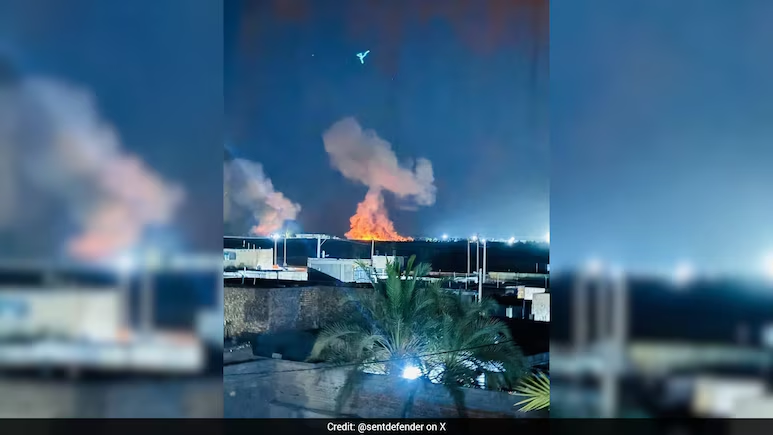
US Central Command released official video footage confirming the new round of retaliatory strikes, which Trump subsequently shared additional clips of on Truth Social. Defense Secretary Pete Hegseth detailed the specific targets hit overnight, describing “a big part of what we targeted” as small craft harassing shipping, along with underground facilities storing drones and missiles, coastal defense sites, radar installations, and surveillance sites used to monitor and disrupt traffic through the Strait of Hormuz.
According to Iranian state media, explosions were reported across multiple cities: roughly 10 explosions were heard in Chabahar and Konarak on Iran’s southern coast, cutting power to part of Chabahar, while additional explosions hit Bandar Abbas and Sirik near the strait. Iran’s semi-official Mehr News agency said the Bushehr nuclear power plant sustained no damage, despite strikes hitting other parts of the city, adding there was “no cause for concern.”
Iran Strait of Hormuz Strikes: Tehran’s Response
Iran did not back down in the face of Trump’s warnings. The Islamic Revolutionary Guard Corps (IRGC) and Iranian army launched projectiles toward Bahrain and Kuwait in response and shot down a US drone. Iran has continued to assert its right to control the Strait of Hormuz, rejecting the framing that its actions violated the memorandum of understanding (MoU) it signed with the US the previous month.
Trump’s Warning of Further Escalation
Trump was direct about what would follow any additional Iranian attacks: “If it happens again, it will get much worse!” he wrote on Truth Social. Asked whether the US was prepared to return to full-scale military conflict, Trump said, “I don’t know,” but added: “We’d win it very quickly… We have many ways we can win, but we’ve already won militarily. They have very little, they have very little left.”
Trump NATO Summit Iran Comments: The Rhetoric Escalates
Trump did not soften his language toward Iranian officials during his time in Ankara, calling them “a bunch of scum” and “evil people.” “I don’t like ’em,” he said. The remarks extended a pattern from earlier in his NATO summit appearances, where he had also labeled Iranian negotiators “cuckoo” and accused them of privately agreeing to terms before publicly denying any such agreement had been reached.
Pete Hegseth Iran Targets: Military Details
Beyond the general categories of targets, Hegseth’s comments underscored that the strikes were specifically aimed at degrading Iran’s ability to continue harassing commercial shipping — rather than a broader campaign against Iranian infrastructure unrelated to the strait. That distinction matters for how the strikes are being framed: as a proportionate, if forceful, response tied directly to the shipping attacks, rather than an open-ended resumption of the wider war that began in February.
International Reaction
The European Union’s foreign affairs chief, Kaja Kallas, weighed in on the escalation, calling Iran’s attacks on Bahrain and Kuwait “unacceptable” and stating that Iran had violated the memorandum of understanding by targeting ships near the Strait of Hormuz. “Freedom of navigation must be unimpeded,” Kallas wrote on X. The EU’s response reflects growing international concern over the strait, through which roughly 20% of the world’s oil and natural gas supply passes daily — meaning any sustained disruption carries consequences well beyond the US and Iran directly.
Iran Ships Attacked Hormuz: The Broader Pattern
The overnight strikes and Trump’s subsequent comments mark the latest escalation in a cycle that has repeated multiple times since the original February 2026 outbreak of hostilities between the US, Israel, and Iran. Each time Iran has targeted shipping in the strait, the US has responded with strikes it characterizes as disproportionately forceful — a pattern Trump’s “20 times” framing was designed to reinforce as a deterrent message, both to Iran directly and to the broader international audience watching the conflict unfold.
What Happens Next
Whether Trump’s messaging succeeds in pushing Iran back toward substantive negotiations, as he claimed on Air Force One, or simply sets up the next round of retaliatory strikes, remains an open question. Iran’s continued insistence on asserting control over the Strait of Hormuz — combined with its willingness to shoot down a US drone even after the latest strikes — suggests Tehran has not yet signaled the kind of concession Trump’s “begging for deal” framing implies.