Here’s How the TV Networks Handled Trump’s Highly Unusual Prime-Time Address

Here’s How the TV Networks Handled Trump’s Highly Unusual Prime-Time Address
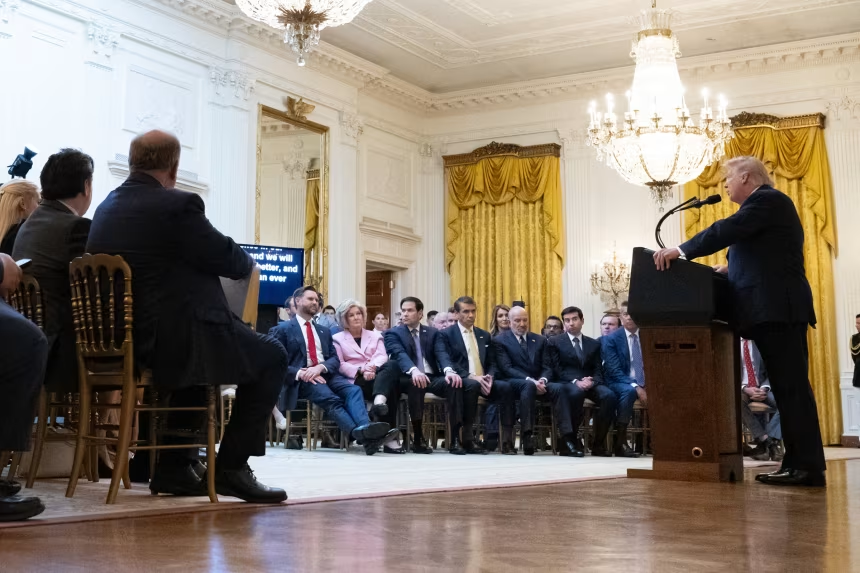
When President Trump took to the East Room of the White House on Thursday night to deliver a primetime address on the 2020 election, the bigger story for much of the media industry wasn’t what he said — it was how, and whether, television networks would show it at all. The result was a rare split-screen moment in American broadcasting: four major networks, four distinct editorial decisions, each reflecting a broader reckoning over how to cover a president with a documented history of spreading falsehoods about elections.
A Newsroom Dilemma Playing Out in Public
Network executives spent hours on Thursday debating how to handle the address, weighing two competing pressures. On one side sat the traditional argument for covering a sitting president’s address to the nation as inherently newsworthy. On the other sat growing unease about handing an unfiltered platform to a speech expected to center on debunked election-fraud claims. As one network executive put it, television no longer operates under the same obligations it did decades ago — there are now far more ways to cover a story than simply airing it live and letting it speak for itself.
That tension produced genuinely different outcomes across the four major broadcast networks, rather than the largely unified coverage presidential addresses have traditionally received.
Who Aired It, and How
ABC and NBC chose not to interrupt their regular primetime lineups at all. Instead, both networks steered viewers to their streaming platforms — ABC News Live and ABC News Radio for ABC, and NBC News NOW for NBC — while continuing to air their scheduled entertainment programming on the main broadcast channel. NBC’s regular lineup that night included a nature documentary narrated by Tom Hanks, while ABC aired its game show slot as usual. Both networks followed up with brief special reports once the address concluded, summarizing and contextualizing what Trump had said rather than airing it live to a mass broadcast audience.
NBC correspondent Hallie Jackson’s assessment of the speech’s substance was blunt: the information Trump presented was largely not new.
CBS, notably, did carry the live address — but wrapped it in what’s sometimes called a “truth sandwich” in journalism circles, surrounding the speech with fact-checking and context both before and immediately after it aired. That approach didn’t fully satisfy critics on either side. Democratic Sen. Mark Warner, appearing on CBS to offer a rebuttal, pushed anchor Tony Dokoupil to more forcefully challenge the president’s claims in real time. Dokoupil responded that he had, in fact, been doing exactly that, noting agreement with Warner that the topic was a serious one and that Trump’s historical track record on election claims was poor. The exchange captured what one observer described as the prevailing mindset inside television newsrooms this cycle: air the speech, but don’t let it go unchallenged.
Fox News also aired the address live, consistent with its typical approach to presidential programming.
A Contrast With How Presidential Addresses Used to Be Covered
Thursday’s split coverage marks a notable departure from how networks have traditionally handled requests for primetime access. In past administrations, broadcast networks largely moved in lockstep — either all carrying an address or, in rarer cases, collectively declining. When President Biden delivered a primetime address in 2022 warning about threats to democracy, ABC, CBS, and NBC all declined to preempt programming, judging the speech too political for live broadcast coverage, though it aired on CNN and MSNBC. A similar dynamic played out in 2014, when major broadcast networks passed on airing President Obama’s address on immigration reform, even as cable news carried it.
What made Thursday’s coverage unusual wasn’t simply that some networks declined to air Trump’s address — it’s that the four major broadcast networks landed in four visibly different places on the same night, each calibrating its own balance between newsworthiness and the risk of amplifying disputed claims without sufficient pushback.
The Political Backdrop
The address itself focused heavily on Trump’s long-running claims about the 2020 election, including newly declassified intelligence he said demonstrated foreign interference. He used the speech to again press Congress to pass the SAVE America Act, controversial voting legislation that requires proof of citizenship to register and photo identification at the polls. Critics, including fact-checkers who reviewed the speech afterward, noted that Trump did not present evidence that any entity had altered the actual outcome of the 2020 election, despite years of claiming the race was stolen from him.
That backdrop is precisely what made the coverage decision so fraught for network executives. A presidential address is, under ordinary circumstances, treated as default appointment viewing across the dial. But when the subject matter includes claims that intelligence agencies and independent fact-checkers have previously disputed, networks are forced to weigh their traditional deference to the office of the presidency against their responsibility not to serve as an uncritical megaphone for disputed claims.
Regulatory Pressure in the Background
Compounding the decision-making was the broader political environment surrounding broadcast regulation. Networks weighing whether to air the address were also navigating the possibility of backlash from the White House and scrutiny from a more assertive Federal Communications Commission — a dynamic that has increasingly shaped how networks approach politically sensitive presidential programming in recent years, adding a layer of institutional caution beyond simple journalistic judgment calls.
What It Signals Going Forward
Thursday night’s divided coverage may prove to be more than a one-off. As Trump continues to request primetime access for addresses built around contested claims, networks appear to be settling into individualized approaches rather than a shared industry standard — some opting for streaming-only access paired with post-speech context, others choosing live coverage paired with real-time fact-checking, and still others airing the address largely at face value.
For viewers, that means the experience of watching a presidential address increasingly depends on which channel — or app — they happen to open. And for network executives, Thursday’s address offered a preview of a recurring challenge: how to balance the historic weight of the presidency with the modern responsibility of not simply handing over the microphone.